Austin, TX · Electric Motor Repair
Electric motor repair in Austin, TX
When a motor goes down in an Austin plant, pump station, or mechanical room, you need a shop that can find the fault, fix it, and get the unit back on its base without a week of guessing. Lopez Electric Motor Works provides electric motor repair for industrial and commercial customers in Austin and across Central Texas: AC and DC motor diagnostics, rewinding, rebuilding, and testing, with 24-hour turnaround as the shop’s specialty.
We’ve repaired motors since 1972, more than 50 years as of 2026, and three generations of the Lopez family have kept the business going. Shop work is done at our facility in San Antonio, and Austin customers reach us directly at 512-788-4594. We don’t have an Austin storefront, so the first call is where we work out what failed, how urgent it is, and how the motor gets to the shop and back.
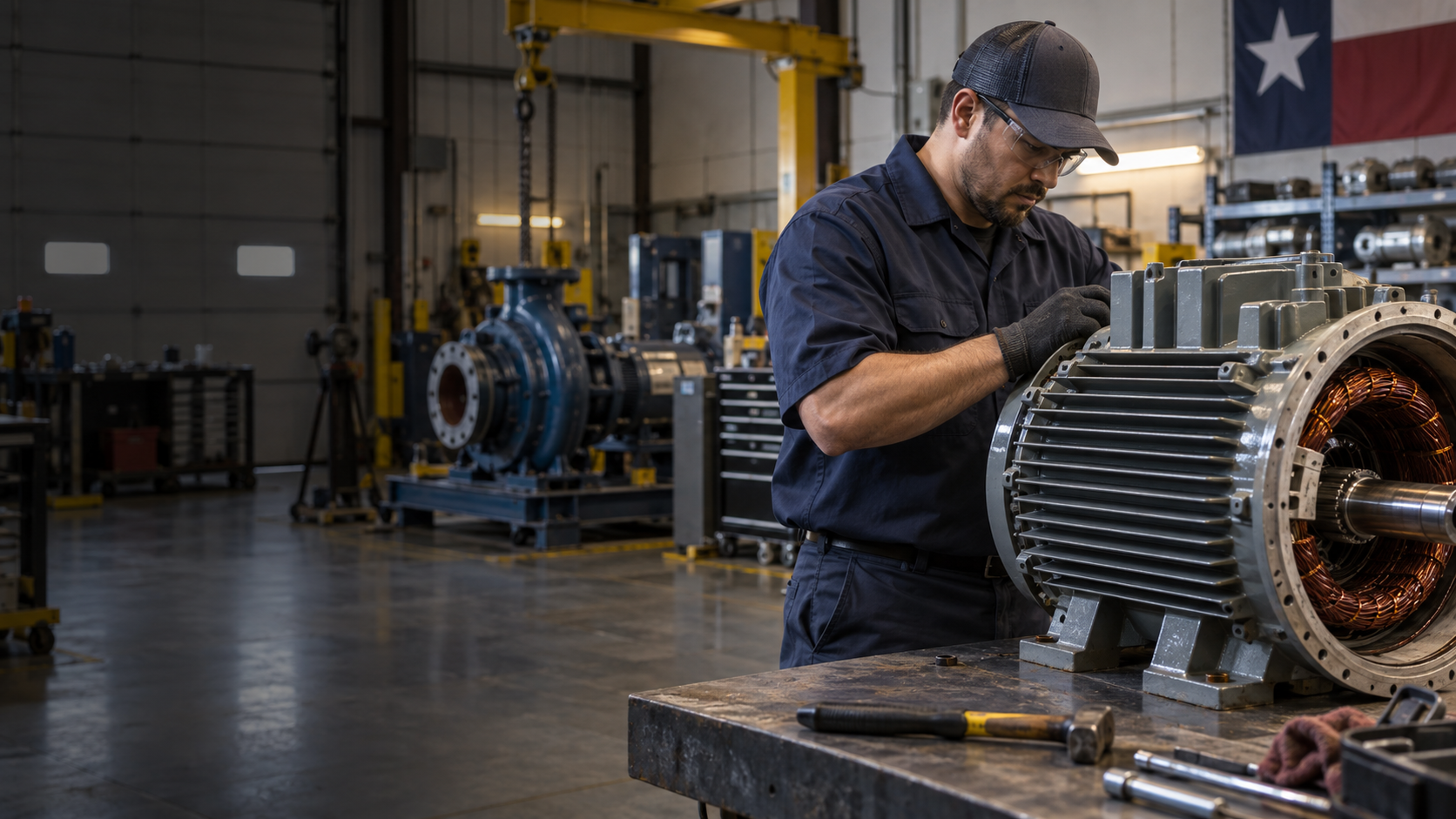
What our motor shop works on
The motor you’re calling about is usually the one behind something your facility can’t run without, such as a pump, a fan, a compressor, a conveyor, or process equipment. Plenty of them sit in mechanical rooms, driving the air handlers and pumps that keep a building’s HVAC running. The work falls into three kinds of jobs, and many repairs involve more than one:
Diagnostics and testing.
Electrical tests on the windings and a mechanical check of the bearings, shaft, and housing, so the repair is aimed at the failure that stopped the motor.
Rewinding.
Replacing a winding whose insulation has broken down from heat, moisture, contamination, or age. That covers AC stator windings and the armature and field windings in DC machines.
Rebuilding.
New bearings and worn mechanical parts, a thorough cleaning, and careful reassembly for motors whose windings are still sound.
Condition checks.
Testing on motors that run hot, sound rough, or trip, so a worn bearing or a weak winding is caught before the motor stops.
A common worry is that a rewound motor comes back less efficient. The Electrical Apparatus Service Association (EASA) and the UK’s AEMT tested that with third-party labs in 2003 and again in 2019, and both studies found that motors repaired with good practices keep their original efficiency. The EASA rewind study is free to download.
How a motor moves through the shop
Every motor follows the same path, which keeps the quote tied to what we found:
Intake.
Testing and teardown.
Diagnosis and quote.
Repair.
Test and return.
Follow-up.

Turnaround when the line is waiting
When a critical motor is down, every hour counts, so we prioritize fast turnaround and clear communication from the first call to final delivery. 24-hour turnaround is our specialty, and the quote will tell you whether your repair fits that window or, like a large rewind or a motor waiting on a part, needs longer.
Breakdowns don’t keep business hours, so 24-hour emergency service is available for critical failures. If nobody can tell yet whether the problem is the motor, the power supply, or the controls, our technicians can come to the site and trace it before anything gets pulled.

Should the motor be repaired or replaced?
Repair usually wins when the motor is large, built for a special mount or duty, slow to source new, or otherwise in good shape with a single failure such as worn bearings or a burned winding. Replacement makes more sense when a small standard motor costs less new than a rewind, when the frame, core, or shaft is damaged, or when the energy savings of a higher-efficiency motor justify the swap. The U.S. Department of Energy publishes software tools and guidance for motor systems if you want to run that energy math yourself.
A motor that fails the same way twice usually has a cause outside the motor, such as a pump bearing loading the shaft, a starter dropping a phase, or a drive set up for the wrong motor. Because we also rebuild the pumps these motors turn and build controls that start and protect them, we can check the equipment on both sides of the motor. If replacement is the better answer, we can find a matching unit for you and give you the numbers for both options.
What to have ready when you call
A few details make the first conversation faster and the quote more accurate. A phone photo of the nameplate covers the first item:
- Nameplate data: horsepower, voltage, RPM, frame, and enclosure type.
- What the motor drives, and whether it runs on a VFD, a soft starter, or an across-the-line starter.
- The symptoms you noticed, such as a burning smell, humming without turning, a tripping breaker, overheating, or bearing noise.
- Whether it stopped suddenly or declined slowly, and anything that changed recently, like a power event or a new load.
- Whether you have a spare, and where the motor is in the Austin area.
Electric motor repair for Austin and nearby cities
The Austin line covers motor repair for plants, utilities, and commercial facilities in Austin, Round Rock, Georgetown, Pflugerville, Cedar Park, Leander, Hutto, Taylor, Kyle, Buda, and San Marcos. These are service areas, and the repair work itself happens at our San Antonio shop.
Service area. Repairs done at our San Antonio shop.
Get a motor back in service
Electric motor repair questions
How much does it cost to rewind an electric motor?
The cost depends on the horsepower, voltage, winding type, and what else the teardown turns up, so we don’t quote a rewind blind. After inspection, Lopez Electric Motor Works gives you a quote, and if a new motor would cost less, we’ll tell you that too.
What is the most common cause of electric motor failure?
Bearing failure and winding insulation breakdown account for most motor failures. Bearings usually fail from lubrication problems, misalignment, or contamination. Windings usually fail from heat caused by overloading, blocked ventilation, voltage imbalance, or too many starts, or from moisture getting into the insulation.
How do you know an electric motor is going bad?
Watch for a motor that runs hotter than usual, growling or grinding from the bearings, new vibration, a burning or varnish smell, and overloads that trip more often. Catching it at this stage often means the repair is a rebuild done before the winding is damaged, so it’s worth calling before it stops.
Do you have a motor shop in Austin?
No. Our shop is in San Antonio, and Austin is part of our service area. Austin customers call 512-788-4594 to reach the same team, and we’ll work out with you how the motor gets to the shop and back.
More services for Austin facilities
Industrial pump repair
Inspection, rebuild, and testing of industrial and commercial pumps, plus the motor that drives each one.
02Custom control panels
Motor control centers, VFD enclosures, and custom panels built and wired for your equipment.
03Building automation
HVAC controls integration, upgrades, and troubleshooting for Austin commercial and industrial facilities.
04Field service
On-site troubleshooting and 24-hour emergency response for motors, pumps, drives, and controls.
05Motor, pump & drive sales
New motors, pumps, and VFDs, plus hard-to-find replacements matched to your application.
06All Austin services
Every service we offer Austin facilities, the cities we cover, and how to reach the Austin line.