Austin, TX · Building Automation
Building automation and HVAC controls in Austin, TX
Building automation ties a facility’s HVAC equipment to one set of controls, so schedules, setpoints, and alarms are managed in one place and problems show up before the people in the building feel them. Lopez Electric Motor Works provides building automation and HVAC controls work for commercial and industrial facilities in Austin. We connect equipment, improve visibility into how it runs, and troubleshoot or upgrade controls that have stopped doing their job.
What sets this work apart is what sits behind the controls. An alarm on a building automation system often points at a fan motor that’s failing, a pump that won’t stage, or a drive that keeps faulting. Motors are what we’ve repaired in our shop since 1972, and pumps, drives, and controls are part of the same business today. The shop is in San Antonio, Austin is part of our service area, and the Austin line at 512-788-4594 reaches the team directly.
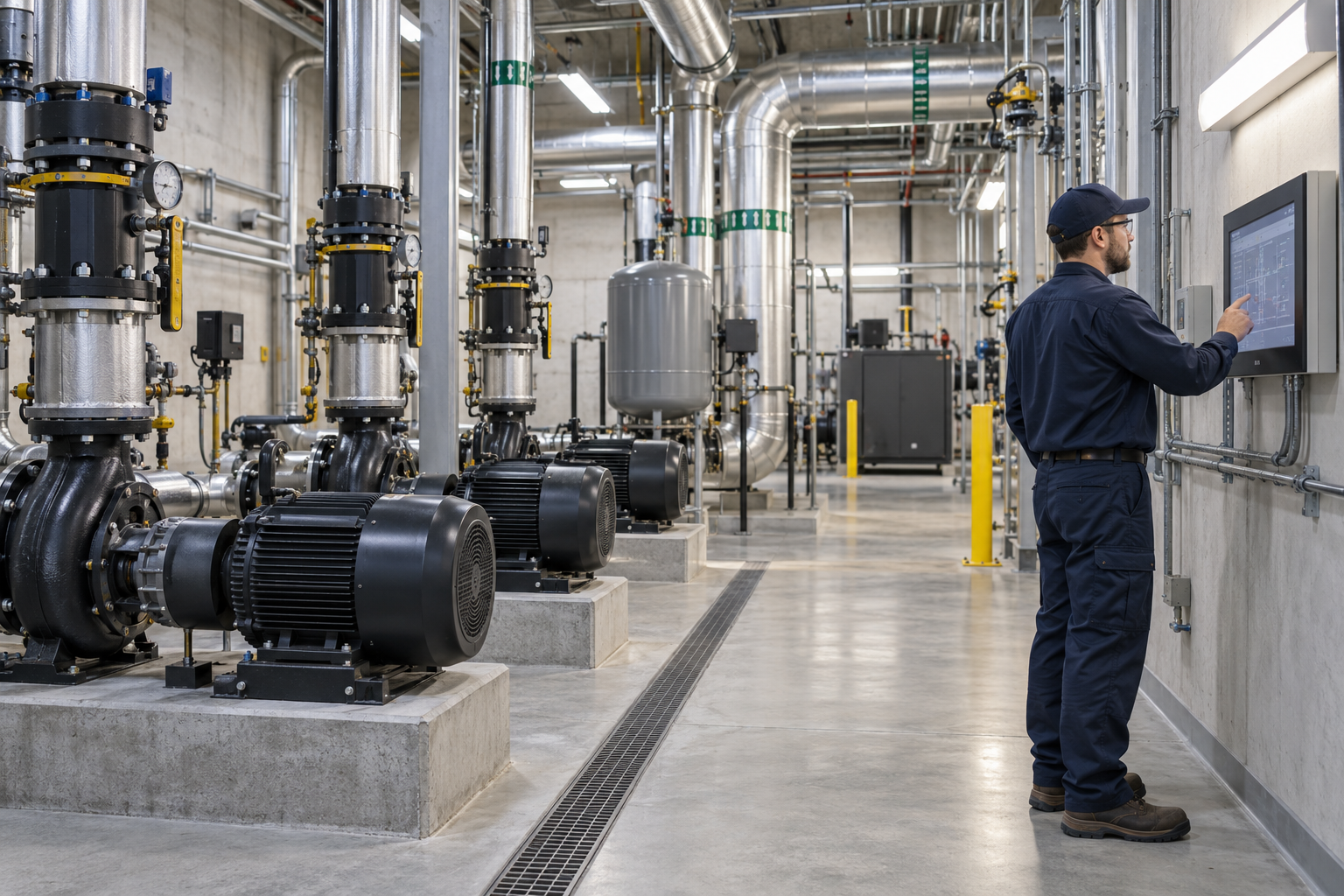

What a building automation system does
A building automation system (BAS), also called a building management system (BMS), runs HVAC equipment on schedules and sequences, so nobody has to remember to flip a switch. Controllers read sensors for temperature, pressure, humidity, and flow, then drive valves, dampers, fans, and pumps to hold the setpoints you’ve chosen. A supervisory front end lets your team see the whole building, change schedules, and respond to alarms without walking every mechanical room.
Set up well, the system keeps equipment off when the building is empty and flags a struggling unit before it fails. Variable frequency drives on air handler fans, cooling tower fans, and pumps let the system match speed to the actual load, which is where much of the energy savings in a controls upgrade comes from.
Controls work we handle in Austin facilities
Our building automation work centers on getting equipment connected, visible, and running the way it was designed to run. Typical projects include:
Connecting HVAC and facility equipment to a building automation system so it can be scheduled, monitored, and alarmed.
Controls upgrades that replace failed or outdated controllers and add the points a facility team needs to see.
Troubleshooting sequences that misbehave, such as equipment running after hours, short cycling, valves hunting, or rooms that never reach setpoint.
VFD integration on fans and pumps, including supplying the drive itself, its wiring, and its control signals.
Repair of the motors and pumps the system controls, handled in our own shop.
Schedule and setpoint cleanup, so equipment runs when the building needs it and holds the conditions it should.
Some equipment needs its own panel before it can join the system, and for that we design panels built around the equipment and connect them to the building controls. That comes up often with pumps and older equipment that has no network connection of its own.
How a controls project runs
Controls problems are easier to fix when they’re diagnosed on site, so most projects start with a walkthrough:
Walkthrough.
Findings and proposal.
Installation or upgrade.
Checkout.
Handoff.
Follow-up.
Response when building controls fail
A building that’s lost cooling in an Austin summer can’t wait for a quote cycle. 24-hour emergency service is available for critical failures, and our technicians can troubleshoot on site to find out whether the problem is the controls, the power, or the equipment itself. If a motor or pump has to come out, 24-hour turnaround is our shop’s specialty.

When does a controls retrofit make more sense than a new system?
A retrofit is usually the right call when the existing controllers still work and are supported, and the gap is integration, programming, or a few failed devices. Replacement makes more sense when controllers are obsolete, when a closed proprietary system blocks changes, or when the front end can’t be updated. Open protocols such as BACnet, which ASHRAE’s SSPC 135 committee maintains as of 2026, make it easier to keep what works, and we’ll tell you which parts of the system are worth keeping.
Working alongside Austin mechanical contractors
If you’re a mechanical contractor in Austin with a project that needs controls work, VFD integration, or motor and pump repair, we fit in as the controls and electromechanical side of the job. We’re not a mechanical contractor, and we don’t install ductwork or piping. Facility managers can use us the same way, as the team that understands both the control sequence and the motors, pumps, and drives behind it.
What to gather before we talk
A few details make the first call more useful, though none of them should hold it up:
- Building type, approximate size, and normal occupied hours.
- The major equipment, such as air handlers, rooftop units, chillers, boilers, pumps, and exhaust fans, and which of them run on VFDs.
- The existing controls, including the manufacturer, the front end, and whether anyone still supports it.
- The problem you’re trying to solve, whether that’s comfort complaints, energy use, alarms, after-hours runtime, or no remote access.
Austin-area buildings we serve
The Austin line covers building automation work for facilities in Austin, Round Rock, Georgetown, Pflugerville, Cedar Park, Leander, Hutto, Taylor, Kyle, Buda, and San Marcos. These are service areas supported from our San Antonio shop, and three generations of family ownership have kept the same standard since 1972.
Service area. Repairs done at our San Antonio shop.
Bring us your controls problem
Building automation questions
How much does a building automation system cost?
The cost depends on how many points (sensors, devices, and control outputs) the system has to handle, what equipment it controls, and how much existing wiring and hardware can be reused. A retrofit that keeps working controllers costs less than a full replacement. Lopez Electric Motor Works prices each job after a walkthrough, so the number reflects your building.
What is the difference between SCADA and a BMS?
Both use controllers and a supervisory front end. SCADA (supervisory control and data acquisition) is built for process and utility systems that are often spread across many sites, such as water and wastewater pump stations. A BMS, or building automation system, is built to run the HVAC and related equipment inside a building or campus.
Can you work with the building controls we already have?
Often, yes. Controllers that communicate over open protocols such as BACnet can usually be integrated and kept in service. Older proprietary systems may need a gateway or replacement, and we’ll tell you which applies after looking at the system.
Why does our HVAC equipment run when the building is empty?
The usual causes are a schedule that was overridden and never restored, equipment left in hand mode at the starter or drive, a failed sensor feeding the controller a false reading, or a setpoint that can’t be reached. A controls check on site will find which one it is.
More services for Austin facilities
Electric motor repair
AC and DC motor diagnostics, rewinding, rebuilding, and testing with 24-hour turnaround.
02Industrial pump repair
Inspection, rebuild, and testing of industrial and commercial pumps, plus the motor that drives each one.
03Custom control panels
Motor control centers, VFD enclosures, and custom panels built and wired for your equipment.
04Field service
On-site troubleshooting and 24-hour emergency response for motors, pumps, drives, and controls.
05Motor, pump & drive sales
New motors, pumps, and VFDs, plus hard-to-find replacements matched to your application.
06All Austin services
Every service we offer Austin facilities, the cities we cover, and how to reach the Austin line.